Introduction
In the Philippines, national roads are vital for transportation, disaster response, and the movement of goods and services. However, these roads are often obstructed by illegal structures, utility poles, debris, and informal businesses—especially after calamities. Recognizing the risks these pose, the Department of Public Works and Highways (DPWH) has long enforced policies to protect the Right-of-Way (ROW) of national roads.
Early DPWH Efforts (2000–2012)
As urban areas expanded and roadside encroachments became more frequent, the Department of Public Works and Highways (DPWH) issued several Department Orders (DOs) between 2000 and 2012 to regulate the use of the Right-of-Way (ROW). These included:
- DO No. 15 (2000) – Promoted tree planting along national roads
- DO No. 52 (2003) – Called for the removal of obstructions and illegal use of the ROW
- DO No. 38 (2006) – Amended tree planting policies under DO 15
- DO No. 29 (2012) – Strengthened enforcement against illegal roadside structures
Adopt-a-Tree Project & DPWH DO No. 73
In the decade since Super Typhoon Haiyan devastated Tacloban City, survivors have fought not only to rebuild homes but also to restore balance between people and nature. One of the initiatives born of this struggle is the Adopt-a-Tree Project along the Tacloban Bypass Road — envisioned as a living green corridor that provides safety, resilience, and beauty. Yet today, this vision faces a formidable obstacle: DPWH Department Order No. 73, Series of 2014, which bans planting and utility installations within the Right-of-Way (ROW) of national roads.
From Local Meetings to a National Appeal
What began as a local interagency dialogue has quickly evolved into a national policy question.
- On August 7, 2025, the first interagency coordination meeting was held to address the Adopt-a-Tree Project’s challenges, centering on ROW acquisition and encroachment.
- On August 12, a joint site inspection confirmed the existence of ROW obstructions.
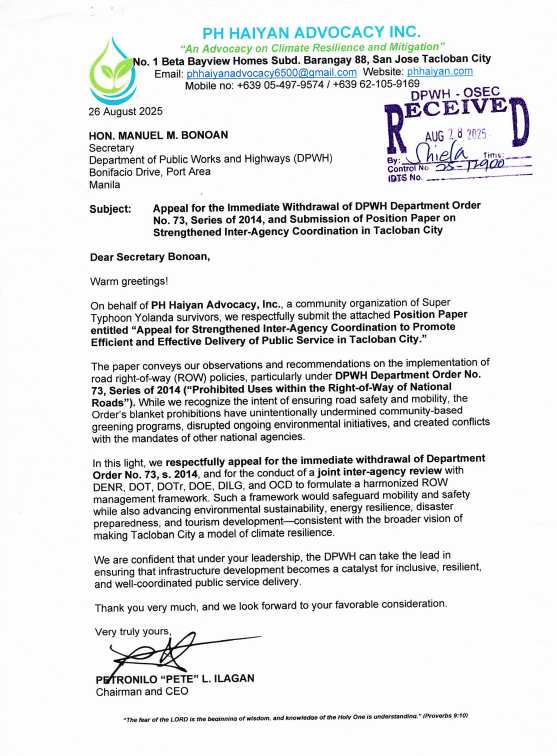
By the second meeting on August 19, participants raised the most pressing concern: DPWH DO No. 73 (2014) — a blanket ban that directly contradicts earlier DPWH greening directives like DO No. 15 (2000) and DO No. 38 (2006).
Faced with this contradiction, PH Haiyan Advocacy, Inc. submitted a Position Paper and Appeal on August 26, 2025, formally addressed to seven national officials:
- Secretary, DPWH
- Secretary, DENR
- Secretary, DOT
- Secretary, DOTr
- Secretary, DOE
- Secretary, DILG
- Administrator, OCD
Key Arguments from the Position Paper
The Position Paper emphasizes that while road safety and mobility are important, policy silos create conflicts and inefficiencies. Among its central points:
- DPWH must align infrastructure with environmental mandates and provide access roads for adjacent lot owners.
- DENR’s National Greening Program (NGP) is undermined if tree planting is prohibited in all ROWs.
- DOT should harness scenic routes like the Tacloban Bypass for eco-tourism, not bare infrastructure.
- DOTr must harmonize transport systems with roadside greening and long-term traffic planning.
- DOE can make roadside utilities resilient and integrate renewable energy and road lighting.
- DILG must supervise LGUs to ensure ROW clearing, proper drainage, and community consultation.
- OCD should guarantee that all road projects meet disaster and climate resilience standards.
A Stronger Vision for Public Service
In its Appeal Section, PH Haiyan Advocacy calls for:
- Immediate withdrawal of DO No. 73 (2014).
- A joint interagency review of ROW policies.
- Conditional tree planting within ROWs, using safe design and engineering standards.
- A Unified Framework balancing road safety, environment, tourism, energy, disaster resilience, and local governance.
- Creation of a Multi-Agency National Task Force to audit and set uniform standards for roads nationwide.
The paper’s conclusion is both urgent and hopeful:
“The state of our national road network reflects not just government competence but also national pride. With unified inter-agency coordination, we can create safer, greener, and more traveler-friendly roads that foster local development, boost tourism, and provide a standard of service every Filipino deserves.”
Why This Matters Nationwide
Though rooted in Tacloban, the appeal highlights a nationwide dilemma: fragmented policies that pit one agency’s mandate against another’s. Roads remain unsafe or underutilized, greening programs stall, utilities lack resilience, and communities feel sidelined.
For survivors of Typhoon Haiyan, the lesson is clear: disaster resilience requires cooperation, not silos. The Adopt-a-Tree Project is more than a roadside initiative. It is a test of whether national agencies can harmonize their mandates to serve people, protect the environment, and build resilience against the next Yolanda.
The question is now before seven national leaders: Will we choose bare roads, or living corridors of resilience?
×
Letters to 7 Secretaries